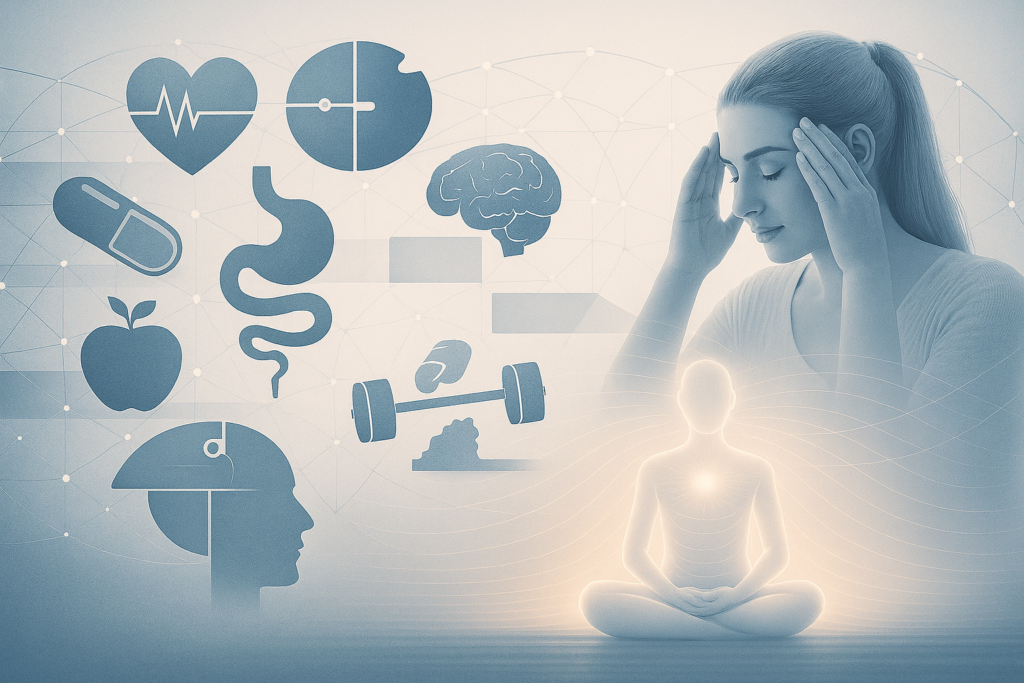
Traditional Wellness, Understanding why effort, discipline, and good habits don’t always lead to lasting health — and what’s been missing.
If you’ve ever felt like you’re doing everything “right” but still don’t feel well, you’re not alone.
Many people eat better, exercise regularly, manage their stress, and invest time in self-care, yet still feel tired, tense, unfocused, or out of balance. For some, progress comes in waves. For others, it never fully arrives.
This experience isn’t a personal failure. And it’s not a lack of willpower.
Many people notice this pattern most clearly when they try to rest. They slow down, follow the advice, and still wake up tired, as if their systems never fully shut down.
It’s often a sign that traditional wellness approaches address parts of the system but not how the system functions as a whole.
The Problem With a Fragmented View of Health
This isn’t a criticism of traditional wellness practices; many are helpful and well-intentioned.
Modern wellness is largely built on specialization. One approach focuses on nutrition. Another movement. Another on mindset, sleep, supplements, or stress management.
Each of these areas matters. But when they are treated in isolation, something important gets missed.
Our bodies aren’t made up of separate, unrelated parts. Physical health, mental sharpness, emotional steadiness, and the ability to recover are interconnected; they communicate with one another through the same internal systems. When one area gets stressed or overloaded, it doesn’t just stay there; the effects can be felt everywhere.
Yet, traditional wellness often tells us to double down on specific habits, eat better, exercise more, and meditate, without first considering if our bodies are actually in a place to benefit from those changes.
Why Effort Alone Isn’t Enough
One of the most common assumptions in wellness culture is that more effort leads to better results.
If you’re tired, try harder to rest. If you’re stressed, add another tool. If progress stalls, increase discipline.
While effort has its place, it doesn’t always address the underlying issue.
For example, someone might follow a well-designed exercise routine and nutrition plan, yet feel increasingly sore, depleted, or restless instead of stronger.
When the nervous system is overloaded or constantly adapting to stress, the body prioritizes survival and efficiency over growth and repair. In that state, even healthy behaviors can feel draining instead of supportive.
This is why two people can follow the same wellness plan and have very different outcomes. The difference often isn’t the plan, it’s the state of the system receiving it.
What’s Often Missing: System Regulation
At the center of lasting health is regulation, the body’s ability to move smoothly between activity and recovery, stress and rest, focus and restoration.
When regulation is compromised, signals within the body become less clear. Recovery takes longer. Stress lingers. Small challenges feel bigger than they should.
Traditional wellness approaches don’t always address this directly. They may assume regulation will improve automatically once habits are in place. For many people, that assumption doesn’t hold.
This is where Energy Wellness offers a different perspective.
A Whole-System Perspective on Wellness
Energy Wellness examines how information flows through the body and how the body responds to its environment.
Instead of focusing only on what someone is doing, it considers how the system is responding. Is the nervous system supported? Is communication clear? Is the body operating in a state of constant adaptation, or does it have space to recover and reorganize?
From this perspective, symptoms are not isolated problems to fix. They are signals that indicate how the system is performing.
When regulation improves, many other aspects of wellness become easier. Movement feels more natural. Rest becomes more restorative. Focus improves. Healthy habits begin to support the body rather than compete with it.
Why This Matters Now
Modern life places ongoing demands on the human system. Constant connectivity, information overload, and long-term stress have become normal.
In traditional wellness, approaches that rely solely on effort and optimization often fall short. They don’t account for the cumulative impact of stress on regulation and recovery.
Energy Wellness isn’t here to throw out what already works. Instead, it helps traditional wellness practices do their job by ensuring your body is in the right state to benefit from them.
Moving Forward With Clarity
Realizing why traditional wellness sometimes doesn’t work can feel like a relief. It’s not about you falling short; it’s often just a sign that what you’ve been trying isn’t matching what your body actually needs.
When people shift from asking, “What else should I do?” to “What does my system need to feel supported?”, the conversation changes.
This shift creates space for more sustainable, effective approaches to health, ones that work with the body instead of pushing against it.
Closing Thought
Wellness is not about doing more.
It’s about creating conditions that enable the body to respond, recover, and adapt naturally.
When those conditions are in place, progress tends to follow.
A Different Way to Think About Wellness
If you’ve tried many approaches and still feel stuck, the issue may not be effort or discipline; it may be how your system is being supported.
Energy Wellness focuses on creating conditions that enable the body to respond more naturally, rather than pushing harder on individual habits.
Explore how Quantum Energy Wellness approaches alignment and whole-system support.
→ Click here to Explore the Energy Wellness Approach
Experience Energy Wellness in Practice
Understanding is one step. Experience adds another layer.
Quantum Energy Wellness offers tools designed to support regulation, coherence, and balance without forcing change.
→ Click here to View Available Energy Wellness Tools